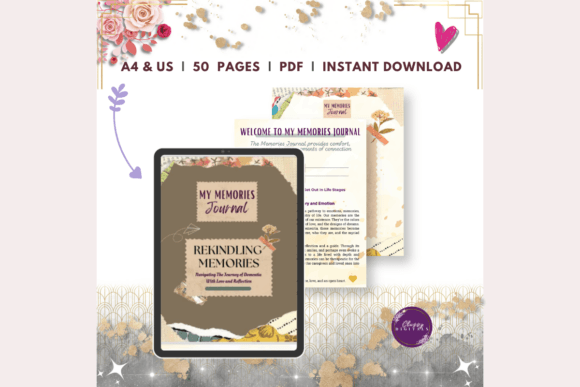
My Memories Journal
Imagine holding not just a notebook—but a lifeline. A quiet, thoughtful tool designed not to document life passively, but to reawaken it. That’s the quiet power of My Memories Journal: a purpose-built memory companion for people living with dementia—and the families who love them. It doesn’t promise miracles. It offers something more grounded, more human: presence, dignity, and connection—page by page.
A Tool Rooted in Neuroscience and Compassion
My Memories Journal isn’t another generic journal with decorative covers and blank pages. It’s structured around evidence-informed memory triggers—sensory prompts, open-ended questions, and gentle scaffolding that aligns with how autobiographical memory functions, especially in early- to mid-stage dementia. Rather than asking “What did you do in 1973?”, it invites: “What scent brings you back to your childhood kitchen?” or “Tell me about a song that made you dance when you were young.” These aren’t trivia—they’re doorways.
Its layout is intentional: generous line spacing, high-contrast typography, minimal visual clutter, and durable, tear-resistant paper. No tiny fonts. No confusing icons. Just clarity—because cognitive load matters. Every design choice supports usability first, aesthetics second.
More Than a Personal Keepsake—A Bridge Across Roles
While born from caregiving need, My Memories Journal resonates across diverse contexts—not as a one-size-fits-all solution, but as a flexible, values-aligned framework.
For Families & Caregivers
Mary didn’t just use My Memories Journal to “record” her father John’s past—she used it to co-create moments. When John hesitated on a prompt about his first job, Mary shared a photo of his old uniform she’d found in a box. He touched the fabric swatch glued beside the prompt, smiled faintly, and said, “Smelled like oil and coffee.” That wasn’t recall—it was reconnection. In homes and care settings, this journal becomes a shared ritual: 10 focused minutes, no pressure, no correction. Just listening, affirming, and anchoring in what remains vivid—even if fragmented.
For Healthcare & Support Professionals
Occupational therapists, memory clinic staff, and dementia support coordinators integrate My Memories Journal into person-centered care plans. Its prompts help identify preserved strengths (e.g., musical memory, emotional vocabulary) and inform activity programming. One geriatric social worker reported using completed journal pages to co-design individualized reminiscence sessions—leading to measurable reductions in agitation during afternoon hours.
For Educators & Students
In aging studies, psychology, and health sciences courses, My Memories Journal serves as both teaching tool and empathy builder. Students complete sample prompts from the perspective of someone with dementia—then reflect on how language, pacing, and sensory grounding shape understanding. It transforms abstract theory into embodied learning.
For Creators & Content Professionals
Writers, podcasters, and documentary filmmakers use the journal’s structure to guide oral history interviews—especially with older adults whose stories risk being lost. Its prompts avoid leading questions and honor ambiguity (“What do you remember most about that time—feeling, sound, or silence?”). That integrity strengthens narrative authenticity and ethical storytelling.
Real-World Impact—Not Just Uplifting Language
Here’s what users consistently observe—not in marketing copy, but in handwritten margin notes and caregiver group discussions:
- Reduced communication strain: Fewer “Do you remember…?” dead ends. More shared laughter over half-remembered nicknames or misremembered dates—accepted, not corrected.
- Improved documentation for care teams: Completed journal entries become meaningful clinical context—revealing patterns (e.g., recurring comfort themes, unmet needs tied to specific eras) that inform care planning.
- Legacy-building without pressure: Unlike digital archives that require tech fluency, My Memories Journal meets people where they are—physically, cognitively, emotionally. Completed journals often become cherished heirlooms, gifted to grandchildren with handwritten notes from the person themselves.
Practical Considerations Before You Begin
If you’re considering My Memories Journal—for yourself, a loved one, or a professional setting—here’s what matters beyond the cover:
- Timing matters more than perfection. Start when energy and attention are relatively stable—not during acute confusion or distress. Even two completed pages, done calmly over a week, hold value.
- Co-creation > completion. You don’t need to “finish” the journal. Use it flexibly: revisit favorite prompts, add photos or small artifacts (a pressed flower, a ticket stub), or read entries aloud together—even if the person doesn’t respond verbally.
- Observe, don’t interpret. Notice what sparks engagement: Is it tactile elements? Music references? Family names? Let those cues guide future use—not assumptions about “what should matter.”
- It complements—not replaces—other supports. Pair it thoughtfully with music therapy, walking outdoors, or familiar routines. Its strength lies in integration, not isolation.
My Memories Journal won’t halt dementia’s progression. But it does something quietly revolutionary: it affirms that identity persists—even when names fade, even when timelines blur. It honors the person behind the diagnosis not through nostalgia, but through attentive, unhurried presence. And in doing so, it reminds us all: memory isn’t just storage. It’s relationship. It’s echo. It’s love, still speaking—just waiting for the right key to unlock its voice again.