Moon Phases Lesson for Kids: Fun, Colorful & Ready-to-Use Learning Made Easy!
Have you ever looked up at the night sky and wondered why the Moon sometimes looks like a bright circle, other times like a thin crescent—or even disappears completely? That’s not magic—it’s science! And it’s one of the most fascinating, hands-on topics kids can explore in early astronomy. A moon phases lesson for kids opens the door to curiosity, observation, and joyful discovery—whether at home or in the classroom.
Why Teaching Moon Phases Matters for Young Learners
Understanding moon phases isn’t just about memorizing names like “waxing gibbous” or “waning crescent.” It’s about building foundational scientific thinking: observing patterns over time, making predictions, connecting cause and effect (Earth’s rotation, the Moon’s orbit), and developing spatial reasoning. These skills support learning across math, earth science, and even literacy—especially when paired with storytelling, art, and movement.
For teachers, a well-designed moon phases lesson for kids aligns seamlessly with national science standards (NGSS K–5 Earth’s Place in the Universe) and supports differentiated instruction. For parents, it transforms bedtime stargazing into meaningful bonding time—and turns screen time into real-world exploration.
What Are Moon Phases—Really?
Moon phases are the changing appearances of the Moon as seen from Earth. They happen because the Moon orbits our planet once every ~29.5 days—and as it moves, sunlight reflects off different portions of its surface. Since only half the Moon is ever lit by the Sun (just like Earth), what we see depends on where the Moon is in relation to Earth and the Sun.
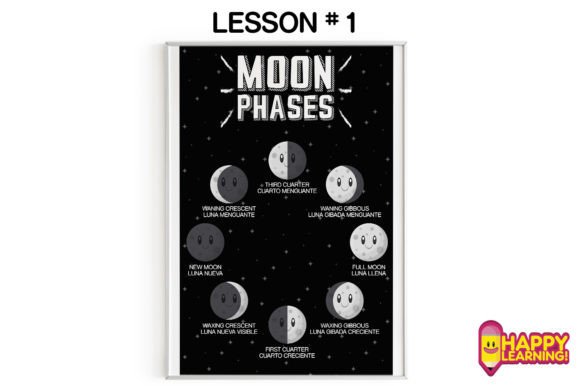
There are eight primary moon phases, occurring in this repeating order:
- New Moon — The Moon is between Earth and the Sun; its dark side faces us (not visible).
- Waxing Crescent — A thin sliver appears on the right side (in the Northern Hemisphere).
- First Quarter — Half the Moon is illuminated (right half).
- Waxing Gibbous — More than half, but not full.
- Full Moon — Entire face is lit and visible.
- Waning Gibbous — Light begins shrinking from the right side.
- Last Quarter — Left half illuminated.
- Waning Crescent — Final thin sliver before returning to New Moon.
Fun fact: “Waxing” means growing larger; “waning” means shrinking. And no—phases aren’t caused by Earth’s shadow (that’s a lunar eclipse!). That’s a common misconception worth gently correcting with visuals and models.
Happiness + Learning = Better Retention
Kids learn best when they’re engaged—not bored, overwhelmed, or disengaged. That’s where colorful, tactile, and playful resources make all the difference. A moon phases lesson for kids happy learning download and print instantly gives educators and caregivers everything needed to spark wonder without hours of prep.
This digital resource includes:
- Two ready-to-teach lessons (27.94 × 43.18 cm)—designed for clarity and visual appeal, with simple language, labeled diagrams, and discussion prompts.
- Two hands-on activities: One smaller (21.59 × 27.94 cm) for cutting, sorting, and sequencing phases; another large-format (43.18 × 27.94 cm) ideal for group work or wall displays.
- Printable card templates—two front designs plus one optional back template—to create durable, reusable flashcards for review games or matching challenges.
- Bonus sticker sheet (JPG)—a joyful way to celebrate progress, reinforce effort, and build confidence. Stickers aren’t just fun—they’re powerful tools for positive reinforcement and intrinsic motivation.
All materials are intentionally oversized for young hands, high-contrast for readability, and rich in visual cues—supporting diverse learners, including those with emerging literacy or sensory processing needs.
How This Fits Into Modern Learning & Daily Life
In today’s fast-paced world, screen-based learning dominates—but research consistently shows that multisensory, offline experiences deepen understanding and improve long-term memory. Printing and assembling moon phase cards, coloring sequence charts, or acting out orbital positions helps children internalize abstract concepts in concrete ways.
Teachers use these materials during science centers, morning meetings, or cross-curricular projects (e.g., pairing moon phases with poetry, journaling, or calendar math). Homeschoolers appreciate the flexibility—lessons adapt easily to 15-minute mini-sessions or extended explorations. Even grandparents and caregivers find them intuitive and stress-free to use.
And because it’s a digital download, there’s no waiting for shipping—no lost pages or mismatched colors. You get instant access, unlimited reprints, and eco-friendly reuse. Just download, print, cut, and learn!
Common Questions—Answered Clearly
“Is this suitable for kindergarten through grade 4?” Yes! Content is tiered: core vocabulary and visuals work for ages 5–7; extension ideas and deeper questions support older elementary students (ages 8–10).
“Do I need special paper or supplies?” No. Standard printer paper works beautifully. For durability, try cardstock or laminate activity sheets. Scissors, glue, and crayons are all you’ll need.
“What if my child struggles with sequencing or abstract thinking?” The included activities scaffold learning step-by-step—from matching pictures to ordering phases to explaining “why” using simple analogies (e.g., “Imagine holding a flashlight and a ball—how does the light hit it as you turn?”).
“Are colors accurate for teaching?” While monitor displays vary slightly, all illustrations prioritize scientific accuracy in shape, orientation, and progression. Real Moon photos are included in lesson extensions to bridge illustration and reality.
Why “Happy Learning” Isn’t Just a Slogan
When children associate science with joy—not pressure or perfection—they develop lasting interest and resilience. Bright colors reduce cognitive load. Clear layouts prevent overwhelm. Playful elements (like stickers and card games) activate dopamine pathways linked to memory and motivation.
This isn’t “cutesy” design—it’s evidence-informed pedagogy. Developmental psychology tells us that emotion and cognition are deeply intertwined. When kids feel capable, curious, and celebrated, they ask more questions, try harder, and remember longer.
Bring the Moon Down to Their Level—Literally
You don’t need telescopes or expensive kits to begin. Start small: go outside tonight and sketch what you see. Keep a simple Moon journal for one week. Sing a moon phases song (many free ones exist online!). Then layer in this moon phases lesson for kids—and watch their confidence grow.
Whether you're a teacher seeking low-prep, high-impact science resources… a parent looking to nurture STEM curiosity at home… or a homeschooler building a joyful, flexible curriculum—this instantly downloadable pack delivers substance *and* sparkle.
It’s more than paper and ink. It’s an invitation—to wonder, to question, to connect with the rhythms of our solar system… and to smile while doing it.
Ready to inspire awe—one phase at a time? Download your Moon Phases Lesson for Kids Happy Learning Pack today. Print, play, explore—and watch their understanding light up, just like the Moon.