Conflict Resolution Flashcards for Kids: A Practical Tool for Social-Emotional Learning
Helping children navigate disagreements, misunderstandings, and social tension is not just about keeping the peace—it’s about building lifelong skills. Conflict resolution flashcards for kids are a simple yet powerful resource designed to support healthy emotional development, strengthen communication, and foster empathy from an early age. With 12 thoughtfully crafted, printable cards—each presenting a realistic scenario and a constructive solution—these tools bridge theory and practice in ways that resonate with children, educators, therapists, and caregivers alike.
What Are Conflict Resolution Flashcards for Kids?
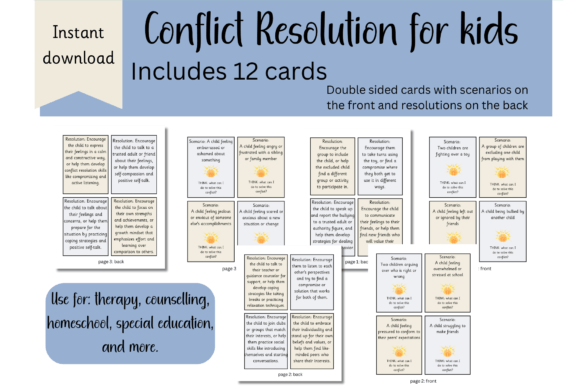
These flashcards are more than colorful visuals—they’re interactive learning prompts rooted in evidence-based social-emotional learning (SEL) principles. Each of the 12 cards features a relatable, age-appropriate conflict children commonly face: sharing toys, joining group play, handling teasing, managing frustration during games, or responding to exclusion. On the reverse side, each card offers a clear, step-by-step strategy—like using “I” statements, taking a breathing break, or asking for help—that guides children toward respectful, nonviolent resolution.
Designed at a child-friendly size of 3.5 x 4.5 inches, the cards fit comfortably in small hands and classroom centers. They come as six high-resolution 8.5 x 11 inch PNG files—each containing four cards—so you can print them double-sided and easily cut them apart. The result? A durable, ready-to-use set of 12 laminated-ready flashcards ideal for repeated use across many settings.
Why Conflict Resolution Skills Matter for Children
Children aren’t born knowing how to manage emotions, read social cues, or negotiate differences. These abilities develop over time—and they develop best through guided, consistent practice. Research consistently shows that early exposure to conflict resolution strategies correlates with:
- Better academic performance (due to improved focus and reduced behavioral disruptions),
- Stronger peer relationships and increased classroom inclusion,
- Lower levels of anxiety—including social anxiety—as children gain confidence in navigating interpersonal challenges,
- Greater emotional regulation and resilience in adolescence and adulthood.
Importantly, these skills are not just “nice to have.” In today’s classrooms—where diverse learning needs, neurodiversity, and heightened awareness of mental health intersect—tools like conflict resolution flashcards provide structure, predictability, and shared language. They turn abstract SEL concepts into concrete actions children can see, say, and practice.
Where and How These Cards Make a Difference
One of the greatest strengths of this resource is its flexibility. Whether used in a therapy office, counselor’s session, general education classroom, special education room, or even at home during homeschooling, these cards adapt seamlessly to different goals and learners.
In the Classroom
Teachers integrate them into morning meetings, SEL blocks, or behavior intervention plans. For example, a kindergarten teacher might introduce “Card #7: Someone took your seat at circle time” and role-play responses as a class. Over time, students begin recognizing patterns—“That’s like what happened yesterday!”—and apply strategies independently.
In Therapy & Counseling
School counselors and licensed therapists use the cards to scaffold conversations, especially with children who struggle to articulate feelings or feel overwhelmed by social expectations. A child with social anxiety may find it easier to point to a card than describe their fear—making the tool both validating and empowering. The visual format also supports neurodivergent learners, including those with ADHD or autism, by reducing verbal load and increasing processing time.
At Home & In Community Settings
Parents and caregivers appreciate having a no-prep, screen-free activity that promotes connection—not correction. Instead of saying, “Use your words,” a parent can pull out Card #3 (“Your friend won’t share the iPad”) and ask, “What could we try together?” This shifts the dynamic from discipline to collaboration.
How These Cards Support Broader Educational Goals
Modern education standards—from CASEL’s SEL framework to state-level early learning guidelines—emphasize five core competencies: self-awareness, self-management, social awareness, relationship skills, and responsible decision-making. These flashcards directly reinforce all five:
- Self-awareness: Scenarios prompt reflection (“How did that make you feel?”).
- Self-management: Strategies like counting to five or naming emotions build regulation tools.
- Social awareness: Cards invite perspective-taking (“How do you think they felt?”).
- Relationship skills: Phrases like “Can I play too?” model assertive, kind communication.
- Responsible decision-making: Each card highlights cause-and-effect thinking (“If I yell, what might happen? What if I ask calmly?”).
This alignment makes the flashcards not only practical but also standards-aligned teacher resources—a key consideration for schools investing in SEL curricula.
Common Misconceptions About Teaching Conflict Resolution
Some adults assume conflict resolution is only for “problem” kids—or that teaching it takes too much time. Neither is true. Conflict is natural, universal, and developmentally appropriate. What matters is *how* children learn to respond. These flashcards don’t eliminate conflict; they normalize it and equip kids with alternatives to aggression, withdrawal, or passive compliance.
Another misconception: that young children are “too little” to grasp these ideas. In fact, brain science shows that neural pathways for empathy and impulse control are most malleable between ages 3–8. Early, playful practice—like matching a feeling face to a card or acting out solutions—builds foundational wiring that lasts.
Getting Started: Tips for Effective Use
You don’t need special training to begin. Here’s how to maximize impact:
- Start small: Introduce one card per week—not all 12 at once.
- Model first: Read the scenario aloud and demonstrate the solution yourself—even if it feels silly.
- Invite participation: Ask open-ended questions: “What would you do?” “What else could work?”
- Connect to real life: When a similar situation arises, gently reference the card: “Remember our ‘taking turns’ card?”
- Laminate for longevity: Especially in high-use environments like classrooms or therapy offices.
Who Benefits Most From These Cards?
While every child benefits from SEL skill-building, these flashcards are especially impactful for:
- Students with social anxiety or selective mutism,
- Children in inclusive or special education settings needing differentiated supports,
- Neurodivergent learners who thrive with visual, structured input,
- English language learners benefiting from predictable language frames,
- Families seeking accessible, therapist-recommended tools for home use.
They’re also invaluable for school social workers and behavior intervention teams looking for research-informed, low-cost interventions that scale across grade levels and student needs.
A Resource Designed for Real Life—Not Just Theory
In a world where digital distractions compete for attention and emotional literacy is often overlooked in favor of academic metrics, tools like conflict resolution flashcards ground learning in humanity. They remind us that education isn’t just about facts—it’s about fostering kindness, courage, and connection. And because they’re printable, adaptable, and grounded in developmental science, they meet families and professionals where they are: without requiring subscriptions, devices, or extensive prep time.
Whether you're a seasoned educator refining your SEL toolkit, a counselor supporting anxious youth, or a parent hoping to nurture compassion at home—these 12 cards offer something rare: simplicity with depth, playfulness with purpose, and practicality with heart.
Ready to bring calm, clarity, and confidence into everyday interactions? These conflict resolution flashcards for kids are more than a teaching aid—they’re a quiet investment in the kind of world we want children to grow up to lead.