Fitness Circuit Station Cards for PE 2: A Practical Tool for Balanced, Scalable Physical Education
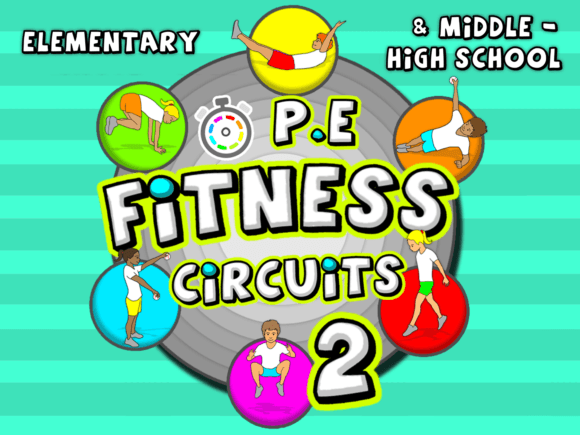
Fitness Circuit Station Cards for PE 2 is a purpose-built set of 36 unique, age-adaptable exercise prompts designed specifically for elementary and middle school physical education. Unlike generic workout posters or broad curriculum guides, this resource focuses on the six foundational elements of childhood fitness: core stability, flexibility, balance, stamina, leg strength, arm strength, and whole-body coordination. Each card presents one clearly illustrated, equipment-light movement—such as banana hold, airplane twist, or foot taps—with concise, student-friendly instructions. The design intentionally avoids complex terminology or abstract concepts, making it accessible to learners from Grade 2 through early middle school without requiring constant teacher demonstration.
How It Fits Into Real-World PE Instruction
In practice, Fitness Circuit Station Cards for PE 2 supports structured yet flexible lesson delivery. Teachers print the cards (A4 or A5), laminate them for durability, and place them around a gymnasium or outdoor space. Minimal equipment—often just cones, a few soft balls, or a bench—is needed. Students rotate in timed intervals (typically 45–60 seconds per station), followed by a 30-second rest before moving on. Music can be used to sustain energy; a whistle signals transitions. This format encourages autonomy, self-pacing, and immediate feedback—students record personal scores (e.g., reps completed or time held) before rotating, fostering ownership and measurable progress over time.
This approach contrasts with more rigid alternatives like scripted lesson plans or digital apps that require devices, internet access, or extensive setup. It also differs from open-ended activity banks where teachers must curate, sequence, and adapt exercises themselves—a time-intensive process many educators lack bandwidth for. Fitness Circuit Station Cards for PE 2 reduces cognitive load on the instructor while preserving pedagogical intentionality. The emphasis on repetition, variation, and progressive challenge across two or three full circuit rounds allows stamina and motor skill development to unfold naturally—not through isolated drills, but through sustained, rhythmic engagement.
Strengths That Support Diverse Classrooms
One of the most practical strengths of Fitness Circuit Station Cards for PE 2 is its built-in scalability. A single card—say, knee pull-ins—can be modified for different ability levels: beginners may perform the movement slowly on the floor, while more advanced students add resistance bands or increase tempo. Similarly, shoulder taps builds core and shoulder stability whether done from hands-and-knees or in a high plank position. This layered accessibility means fewer adaptations are needed on the fly, supporting inclusive instruction across mixed-ability groups without singling out students.
The visual clarity of each card also aids English language learners and neurodiverse students. Icons and simple verbs (“hold,” “tap,” “twist”) reduce reliance on verbal instruction alone. And because the cards are static (not screen-based), they eliminate screen fatigue and technical hiccups—common friction points in tech-dependent PE resources. For schools with limited budgets or inconsistent device access, this low-tech reliability is not just convenient—it’s equitable.
Tradeoffs and Situational Limitations
While Fitness Circuit Station Cards for PE 2 excels in consistency and ease of use, it does not replace deeper instructional scaffolding. It assumes the teacher has baseline knowledge of safe movement mechanics—for example, how to cue proper spinal alignment during back hold or how to spot students attempting wall ball sit-ups. There is no embedded video modeling, safety checklist, or differentiation guide included with the cards themselves. Educators new to fitness instruction—or those working with students who have significant mobility challenges—may need to supplement with additional training or adapted resources.
It also prioritizes breadth over depth. While the 36 exercises cover all six fitness fundamentals, they do not delve into sport-specific skill development (e.g., throwing mechanics, agility ladder patterns, or defensive stances). If your goal is to build toward team sports or competitive readiness, these cards serve best as a conditioning foundation—not a standalone skills curriculum. Likewise, for older middle schoolers approaching puberty, some movements may feel too elementary unless meaningfully extended (e.g., adding instability surfaces to lay twist or integrating breathwork into ball crunches). Context matters: what works seamlessly in a 30-minute Grade 4 PE block may need thoughtful extension in an advanced 7th-grade fitness unit.
When It’s the Right Fit—and When It’s Not
Fitness Circuit Station Cards for PE 2 is especially well-suited for educators who value routine, consistency, and minimal prep time—particularly those managing large classes, rotating schedules, or shared gym spaces. Substitute teachers, long-term substitutes, or support staff unfamiliar with the school’s broader PE framework can implement the circuit effectively with little orientation. It’s also ideal for schools adopting a “fitness-first” philosophy, where building lifelong movement habits takes priority over sport-specific outcomes.
Conversely, if your program emphasizes inquiry-based learning, student-led design, or interdisciplinary connections (e.g., linking movement to science concepts like biomechanics or heart rate), you’ll likely need to layer in discussion prompts, data collection tools, or reflection activities beyond what the cards provide. Similarly, if your school mandates specific assessment frameworks—like rubrics tied to SHAPE America standards—you’ll need to map the activities to those criteria yourself. The cards don’t auto-generate reports or track longitudinal data; they support formative, real-time observation—not summative evaluation.
Practical Comparison With Common Alternatives
Compared to commercially available PE kits—many of which bundle expensive equipment with prescriptive routines—Fitness Circuit Station Cards for PE 2 offers far greater flexibility at lower cost. You’re not locked into branded resistance bands or proprietary timers. You choose the pacing, music, rest intervals, and even how strictly to enforce form—making it adaptable across seasons, weather conditions, and facility constraints.
It also differs meaningfully from free online PDF collections. While many such resources exist, they often lack intentional sequencing, visual consistency, or developmental appropriateness across grade bands. Some include outdated or unsafe movements (e.g., unsupported sit-up variations), while others omit clear progression pathways. Fitness Circuit Station Cards for PE 2 was developed with input from certified PE specialists and reflects current best practices in youth physical development—including avoidance of excessive spinal flexion and emphasis on controlled, functional movement patterns.
Making an Informed Choice
Ultimately, choosing Fitness Circuit Station Cards for PE 2 comes down to alignment with your goals, capacity, and context. Ask yourself:
- Do I need a ready-to-deploy system that supports consistent daily movement, not just occasional units?
- Is my priority building foundational fitness habits across a wide age range—not just teaching discrete skills?
- Do I work in an environment where simplicity, portability, and low-tech reliability matter more than digital interactivity or automated tracking?
- Am I comfortable adapting and extending exercises based on student response—or do I need turnkey, fully scaffolded lessons?
If most answers are “yes,” then Fitness Circuit Station Cards for PE 2 represents a grounded, evidence-informed option—one that respects both child development principles and the realities of modern PE teaching. It won’t solve every challenge, but it removes several common barriers: ambiguity in activity selection, inconsistency in execution, and inequity in access. Used thoughtfully, it becomes less of a product and more of a platform—a stable base from which varied, responsive, and joyful movement experiences can grow.