Vintage Sunflower Flower Patterns
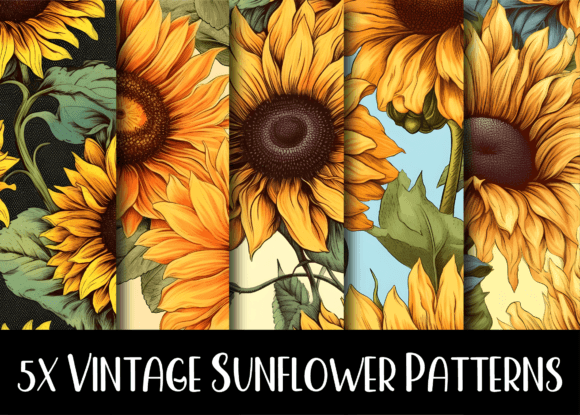
There’s something quietly magical about a sunflower drawn with the gentle hand of a 19th-century botanical illustrator—slightly imperfect petals, delicate veining in the leaves, soft ink washes, and that unmistakable warmth radiating from its center. Vintage Sunflower Flower Patterns captures exactly that feeling: five high-resolution, thoughtfully composed patterns where each sunflower is surrounded by curling, asymmetrical vintage-style leaves—no rigid symmetry, no sterile digital uniformity. These aren’t just floral repeats; they’re time-travel tools for your creative process.
What Makes These Patterns Feel Genuinely Vintage?
It starts with intention. Each pattern was built from hand-drawn elements scanned at high fidelity—not generated by AI or traced from stock vectors. The sunflowers feature subtle texture overlays mimicking aged paper, slight variations in petal opacity (like ink bleeding ever so slightly), and leaf arrangements that echo the organic flow of antique herbals and Victorian wallpaper samples. At 4096×4096px, they scale beautifully—from a tiny journal border to a full-yard fabric print—without losing that hand-crafted nuance.
Where These Patterns Come Alive in Real Projects
You don’t need to be designing a full vintage wedding suite to get meaningful use out of Vintage Sunflower Flower Patterns. Their strength lies in quiet versatility—showing up meaningfully across contexts where authenticity and warmth matter more than trendiness.
Scrapbookers & Journal Keepers
If you’ve ever spent ten minutes searching for *just the right* background paper that doesn’t scream “2024 clipart,” these patterns are your relief. Use one as a full-page backdrop behind handwritten letters or pressed flower photos. Or crop a small section to frame a Polaroid corner—its aged tonality keeps the focus on your memory, not the design. Bonus: because the repeat is generous but not overwhelming, it won’t compete with layered ephemera like ticket stubs or handwritten notes.
Small-Business Owners & Makers
Think of a local herbalist launching a line of lavender honey—Vintage Sunflower Flower Patterns can become the subtle watermark on her product labels, printed in soft sepia on kraft paper. Or a ceramicist using one pattern as a repeat on packaging tissue, tying her earthy mugs and bowls to a cohesive, tactile brand language. It’s not about shouting “vintage!”—it’s about whispering care, continuity, and craft.
Digital Designers & Print-on-Demand Sellers
These patterns convert exceptionally well for surface design. One designer told us she used a cropped variation as a seamless tile for a limited-run notebook collection—and saw a 30% lift in engagement on Instagram posts featuring the notebooks beside vintage books and enamel pins. Why? Because the pattern feels *found*, not fabricated. Buyers sense the intention behind it, and that builds trust before they even read your bio.
Wedding & Stationery Creators
Forget overused watercolor splashes or generic florals. A sunflower pattern with botanical accuracy and gentle aging lends instant heirloom energy to invitation suites—especially when paired with letterpress or foil-stamped text. One couple used a softened version (lowered contrast + warm tone shift) for their rehearsal dinner menus, printed on recycled cotton paper. Guests kept asking, “Where did you find this? It looks like something my grandmother saved.” That’s the effect you want—not “pretty,” but *resonant*.
Educators & Homeschool Families
Teachers building nature study units have used these patterns as printable borders for student botany journals. The detail invites close looking: “Can you spot how many stamens are visible in this bloom?” or “How do the leaves differ between Pattern #2 and #4?” It bridges art and science without needing extra explanation—because the illustration style itself cues observation and curiosity.
Practical Things to Keep in Mind Before You Dive In
While Vintage Sunflower Flower Patterns are designed for broad compatibility, a few real-world considerations help you get the most out of them:
- Color flexibility matters. These JPGs are delivered in rich, warm-toned RGB—but if you’re printing for fabric or stationery, test a small swatch first. Some printers mute sepia tones or add cool casts. Adjusting brightness/contrast in Photoshop or Affinity Photo before output often makes a noticeable difference.
- They’re seamless—but not invisible. Unlike ultra-minimal modern repeats, these patterns celebrate their rhythm. If you need something truly neutral (e.g., for corporate branding), these may feel too expressive. They shine brightest where personality is welcome.
- Layering works best when intentional. Try overlaying one pattern at 15–20% opacity over a cream textured background for depth—or invert the colors for a striking monochrome look on dark cardstock. Avoid stacking multiple patterns unless you’re aiming for maximalist collage energy.
- They’re JPGs—not vectors. So while they scale beautifully up to poster size, they’re not ideal for laser-cutting templates or embroidery digitizing (where vector paths are required). Save them for surfaces, prints, and screen-based work.
Why This Kind of Nostalgia Still Resonates
We’re not reaching for vintage aesthetics because we want to escape the present—we reach for them because they carry weight. A sunflower drawn in 1887 wasn’t just documenting a plant; it was an act of reverence, patience, and attention. When you choose Vintage Sunflower Flower Patterns, you’re borrowing that same intention—not as costume, but as continuity. Whether you’re mailing a thank-you note, launching a small batch of candles, or helping a child sketch leaf veins, the pattern becomes part of a slower, more considered rhythm.
That’s the quiet power here: it doesn’t ask you to recreate the past. It simply offers a visual language that already feels grounded, kind, and quietly confident—so you can focus on what matters most: the person receiving the card, the story behind the product, or the wonder in a child’s voice asking, “How did they draw that so carefully?”