Bathroom Sign Out Sheet
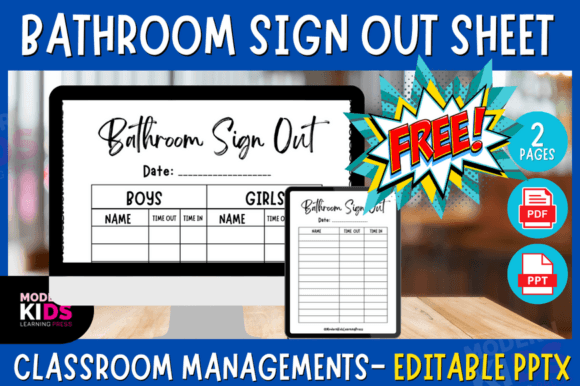
A Bathroom Sign Out Sheet is a simple, low-tech classroom tool that turns an everyday need—using the restroom—into a meaningful opportunity for structure, accountability, and skill-building. It’s not about surveillance or control; it’s about consistency, clarity, and care. At its core, it’s a sheet (often printed and mounted on a clipboard by the door) where students write their name, time of departure, time of return, and sometimes a brief note—like “water fountain” or “quick break.” Teachers use it to gently reinforce expectations while gathering useful, real-time insights about student behavior, timing, and needs.
Where This Tool Fits in Real Classrooms
In a third-grade room during silent reading, Maya raises her hand—not to ask a question, but to go to the bathroom. Instead of calling out or waiting for permission mid-lesson, she walks quietly to the door, picks up the clipboard, signs out at 10:23 a.m., and returns at 10:27 a.m. Her teacher glances at the sheet later and notices Maya’s breaks are consistently short, well-timed, and never overlap with direct instruction. That small pattern tells a story: Maya feels safe, knows the routine, and respects shared classroom time.
Contrast that with a sixth-grade science class where three students leave within five minutes—and two don’t return for nearly 15 minutes. The sign-out sheet doesn’t just flag a concern—it provides neutral, factual data. Was there a hallway delay? A social detour? A moment of overwhelm? With timestamps, teachers can investigate with empathy—not assumption.
More Than Just a Log: Unexpected Benefits Across Grade Levels
- For early elementary students: It doubles as a gentle time-telling practice. Writing “11:04” and “11:08” reinforces digital clock recognition—and when paired with an analog clock nearby, builds cross-modal understanding.
- For neurodivergent learners: Predictability reduces anxiety. Knowing exactly *how* and *where* to request a break lowers executive function load. Some teachers add visual icons (a toilet, a clock, a checkmark) alongside text—making it accessible for non-readers or emerging readers.
- For middle school educators: It supports restorative conversations. If a student repeatedly signs out right before group work, the sheet becomes a conversation starter—not a reprimand. “I noticed you’ve left right before collaborative time the last three days. Is there something about that part of class that feels tricky?”
- For substitute teachers: It’s an instant cultural snapshot. A tidy, consistently used sheet signals strong routines. Gaps or inconsistent entries may hint at unspoken norms—or opportunities to reinforce expectations on day one.
Why Educators Reach for the Editable PPT Version
This Bathroom Sign Out Sheet for Classroom Management – Editable PPT stands out because it meets teachers where they are: pressed for time, needing flexibility, and valuing clean design. You’re not stuck with one font, layout, or grade-level tone. Need space for student ID numbers? Add a column. Want a spot for a quick emoji rating (“😊 I’m fine” / “😐 I need a minute”)? Insert it. Prefer a minimalist black-and-white version for easy photocopying? Done. Or switch to pastel accents for a warmer vibe—no design skills required.
It also solves a quiet pain point: durability. Unlike laminated posters that get smudged or sticky-note versions that vanish, this printable sheet lives on a sturdy clipboard—easy to swap weekly, annotate lightly with a dry-erase marker, or file digitally after scanning.
Practical Considerations Before You Start
Before hanging that clipboard, consider your context—not just the tool.
- Age-appropriateness matters. Kindergarteners may need name stamps or Velcro name cards instead of handwriting. Middle schoolers might prefer anonymity (numbers instead of names) if privacy is a concern.
- Timing isn’t always about urgency. Some students sign out not because they need the restroom—but because they’re overwhelmed, hungry, or need sensory input. Watch for patterns: same time daily? Right after transitions? That’s valuable intel—not misbehavior.
- Consistency builds trust—but rigidity erodes it. If a student is visibly unwell, the sheet shouldn’t be a barrier. Build in grace: “Go now—just sign when you get back.” That models humanity, not bureaucracy.
- Privacy is non-negotiable. Keep the clipboard turned inward or store sheets securely. Never post full logs publicly—even anonymized versions can unintentionally highlight patterns that stigmatize.
Who Else Uses Bathroom Sign Out Sheets—Beyond K–12 Classrooms?
While designed for educators, the concept travels well. Speech-language pathologists use similar logs during pull-out sessions to track how often a child leaves therapy to avoid challenging tasks—helping refine goals. After-school program coordinators adapt them for snack or water breaks, supporting hydration awareness and routine-building for kids with ADHD or autism. Even some Montessori guides use simplified versions—framed as “independence trackers”—to honor choice while nurturing self-awareness.
In vocational training settings, adult learners appreciate the clarity too. A welding instructor uses a sign-out sheet not for restrooms, but for tool checkout—same principle: intentionality, traceability, respect for shared resources.
What It Doesn’t Do (And Why That’s Okay)
A Bathroom Sign Out Sheet won’t eliminate all disruptions. It won’t replace relationship-building or address underlying health needs like UTIs or diabetes-related bathroom frequency. It won’t magically fix a chaotic transition routine—if students are rushing to sign out en masse, the issue may lie in pacing, not the sheet.
Its strength is in its humility: it’s a mirror, not a fix-all. It reflects what’s already happening—so you can respond thoughtfully, not reactively. When used with warmth and intention, it supports autonomy *and* community. Students aren’t just tracking bathroom trips—they’re practicing responsibility, time awareness, and respectful communication—all embedded in one quiet, consistent act.
Getting Started Is Simpler Than You Think
You don’t need buy-in from the district, a budget line, or professional development hours. Open the editable PPT, choose your favorite slide (there are options for primary, upper elementary, and middle grades), print one copy, clip it to a board or binder, and place it beside the door. Model it once—with kindness, clarity, and zero shame. Then watch how quickly it becomes part of your classroom’s quiet rhythm.
Because great classroom management isn’t about perfection. It’s about presence—and tools like the Bathroom Sign Out Sheet help you stay present, informed, and grounded, one thoughtful, timestamped choice at a time.